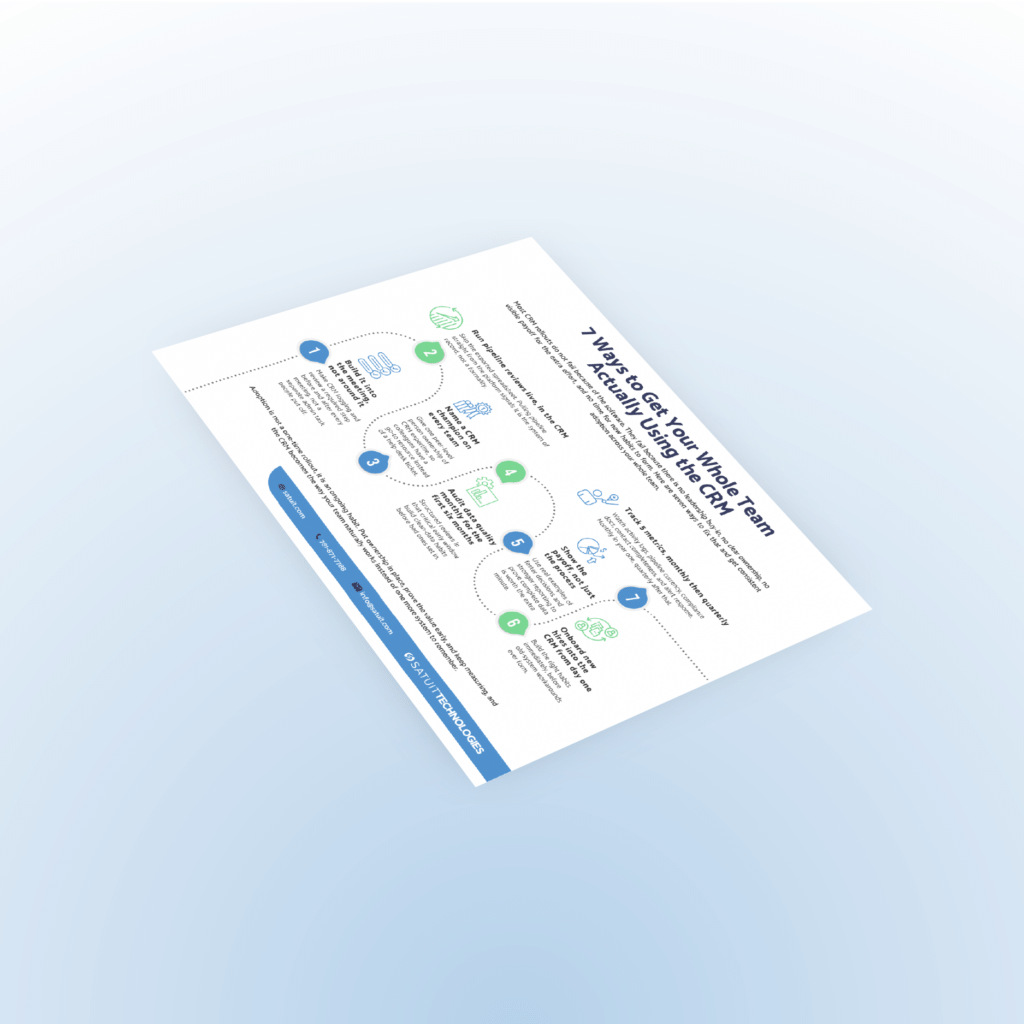
A CRM is only as good as the data in it. And the data is only as good as the people who put it there.
This is the adoption problem, and it’s the reason most CRM implementations at investment firms underperform. The platform is capable. The workflows are configured. The training is complete. And then six months later, half the team is still logging calls in a notebook, and the relationship history in the system is incomplete and out of date.
Building a CRM-first culture means changing how your team thinks about data capture, not just installing software. This guide covers how to do it, from implementation through long-term adoption.
Why CRM Adoption Fails at Investment Firms
Before building the solution, it’s worth understanding the problem. CRM adoption typically fails at asset management firms for one of three reasons:
The platform wasn’t built for investment management
When relationship managers are forced to use a CRM that doesn’t map to how they work, such as the wrong data model, irrelevant fields, or missing workflows, they stop using it. The workarounds are faster. This is why purpose-built platforms like SatuitCRM outperform generic tools like Salesforce or HubSpot on adoption at investment firms. The closer the system matches the user’s actual work, the more naturally they use it. For more on platform fit, read: SatuitCRM vs Salesforce: Why Investment Managers Stop Customizing and Start Closing
Leadership doesn’t use it
When senior partners and the head of IR manage their relationships in their inbox and refer to the CRM as something the junior team does, the message is clear: the CRM isn’t important. Adoption flows downward. If the partners aren’t in the system, no one else believes it matters.
There’s no clear standard for what goes in
When the team doesn’t know what they’re supposed to log: Every call? Just meetings? What counts as a meaningful interaction? The result is inconsistent data that makes the system less useful, which reduces motivation to use it, which makes the data worse. A negative cycle.
Step 1: Set the Standard Before Launch
The most important adoption decision happens before anyone logs in for the first time. Define explicitly what the minimum logging standard is for your firm.
A practical minimum standard for most buy-side IR teams:
- Every investor meeting: date, participants, meeting type, key topics discussed, next action
- Every meaningful call (10+ minutes): date, participants, key topics, follow-up
- Every email sent to an investor or prospect: captured via email integration (not manual entry)
- Every RFP received and its current status
- Every capital commitment, redemption, or AUM change
This doesn’t need to be onerous. The goal is that anyone on the team can pick up any investor relationship and understand where it stands, who last spoke to them, and what was discussed, without calling the relationship manager.
Step 2: Get Leadership in the System First
Adoption at investment firms follows seniority. If the Managing Partner, Head of IR, and CIO are active users, logging their own interactions, reviewing dashboards, and pulling reports from the system, the team follows. If they’re not, the team treats the CRM as administrative overhead.
Before launch, get explicit commitment from senior leaders to:
- Log their own investor and consultant interactions in the system
- Pull their pipeline and activity reports from the CRM rather than asking staff to prepare them manually
- Reference the CRM in weekly IR meetings (“Let me pull that up in Satuit”)
The last point is particularly powerful. When the CRM is the default source of truth in meetings, the system everyone refers to when questions about investor status arise, usage becomes self-reinforcing. For more on building the case for investment in CRM at the leadership level, see: How to Build a CRM Business Case for Your Investment Firm’s Leadership Team
Step 3: Make the CRM the Easiest Path, Not an Extra Step
Adoption drops when the CRM feels like additional work on top of the real job. The goal is to make the CRM the path of least resistance for the tasks people are already doing.
Email integration is the single highest-leverage configuration decision
When the CRM automatically captures email correspondence with investors and prospects, relationship managers don’t have to manually log most of their interactions. They’re already in their inbox; the CRM is capturing it in the background. SatuitCRM integrates with both Outlook and Gmail for automated correspondence capture. For more on available integrations: satuit.com/partners/integrations
Pre-built dashboards eliminate the “what am I supposed to look at” problem
When users log in and immediately see the information relevant to their role, their upcoming meetings, their open follow-ups, and their pipeline status, the system feels useful from the first interaction. SatuitCRM’s customizable dashboards allow each user to build a home page that reflects their actual workload.
Step 4: Measure Adoption Explicitly
What gets measured gets done. If CRM adoption isn’t tracked and discussed, it will gradually erode as priorities compete.
Metrics to track for CRM adoption:
- Interaction logging rate: percentage of investor meetings and calls logged within 48 hours of occurring
- Data completeness: percentage of investor records with complete contact information, relationship history, and AUM data
- Active user rate: percentage of team members who log at least one interaction per week
- Pipeline currency: percentage of pipeline opportunities with a last activity date within the past 30 days
Review these metrics monthly in the first year. When you see a drop in any metric, identify the cause. Is it a specific team? A specific workflow? A platform friction point, and address it directly. For a full list of the metrics that matter most, read: CRM Metrics Every Asset Management Firm Should Be Tracking
Step 5: Connect CRM Data to Business Outcomes
The most sustainable driver of adoption is usefulness. When relationship managers see that the CRM helps them do their job better, not just because leadership wants them to use it, they become self-motivated users.
Demonstrate this connection explicitly:
- Show the team a case where a logged interaction from a colleague allowed them to prepare for a meeting they weren’t involved in
- Pull the pipeline dashboard in an IR meeting to make a real decision about where to allocate team time
- Use CRM data to identify an LP who hasn’t been contacted in 90 days, and turn that into a successful re-engagement
Each of these moments reinforces that the CRM is a professional tool, not administrative overhead. Over time, this shifts the culture from “we log because we’re supposed to” to “we log because it makes us better.” For more on how CRM data connects to business growth, see: Using CRM Insights to Identify Growth Opportunities
Step 6: Reinforce During Onboarding for Every New Hire
The most efficient time to establish CRM habits is when someone is new and still forming their working patterns. Every new IR hire should go through a structured CRM onboarding that covers:
- The logging standard and why it exists
- How to use email integration so they’re not doing manual entry
- How to use their personal dashboard
- Where to find the information they need about their investor relationships
Treat CRM onboarding as seriously as any other part of the role onboarding. The Satuit Training Calendar includes regular training sessions that support new user onboarding.
Common Pitfalls to Avoid
Over-customizing the system at launch
More fields and more required inputs mean more friction and slower adoption. Start with the minimum viable configuration and add complexity as users become comfortable with the basics.
Launching without a data migration plan
If historical investor data isn’t in the CRM at launch, users will default to their old systems to find it. Prioritize migrating existing investor records, interaction history, and AUM data before go-live.
The Long-Term Payoff
Firms that successfully build a CRM-first culture report consistent benefits: faster onboarding of new hires, smoother coverage transitions when team members change, better-prepared investor meetings, and leadership that can make resourcing decisions based on real data rather than individual reports.
The CRM becomes the institutional memory of the firm, a record of every investor relationship, every consultant interaction, and every business development activity that persists regardless of who is on the team. That asset becomes more valuable every year that the discipline is maintained.
For more on what that looks like in practice, download the CRM Scalability Checklist or watch the webinar: Building a Culture of CRM for AUM Generators
Ready to build a CRM-first culture at your firm? Schedule a demo of SatuitCRM.